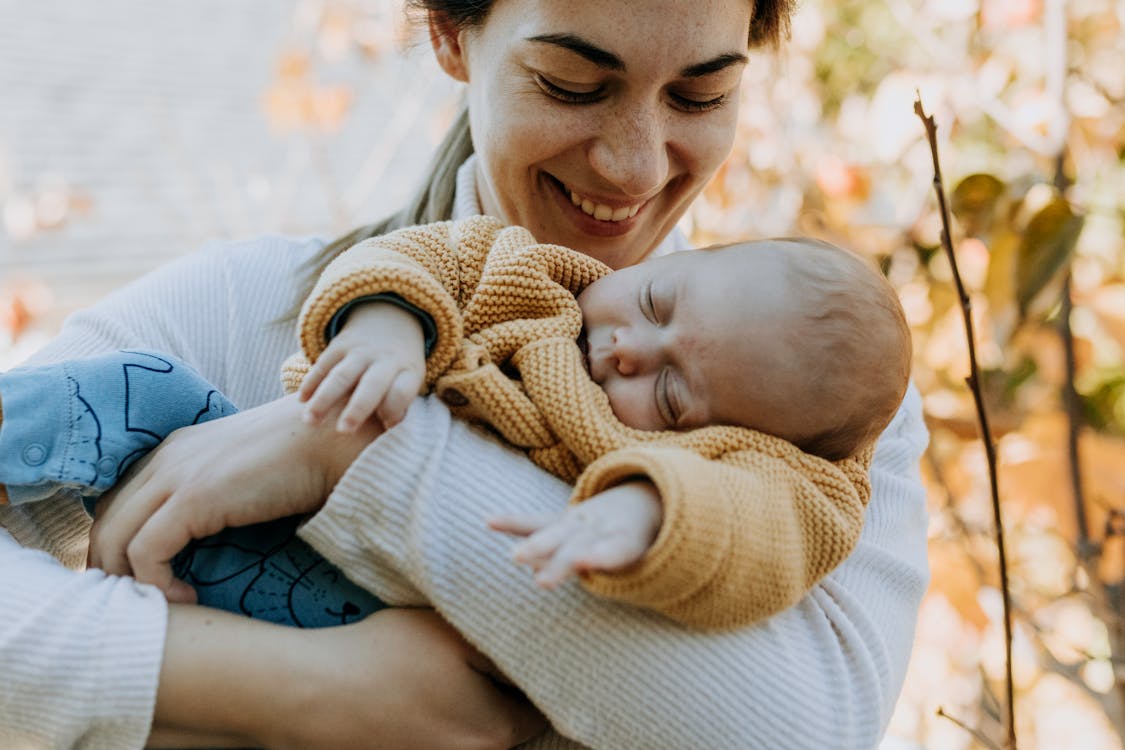
When does a child recognise their own name?
Parents often wonder: at what age does my baby first recognise their own name? And when does a child truly know that this name refers to them? The answer comes from more than thirty years of developmental research, and the path is more layered than you might expect. Children pass through four recognisable stages, from sound pattern to written letters.
Stage 1: 4 to 6 months: recognising the sound of one’s own name
Long before a baby uses their name, the brain already picks up the sound pattern as something special. In a landmark experiment, Mandel, Jusczyk and Pisoni (Psychological Science, 1995) showed that infants of around 4.5 months listened significantly longer to their own name than to other names with the same stress pattern. The researchers used the head-turn preference procedure: babies effectively “voted” by turning their head towards a sound source.
A follow-up by Imafuku and colleagues (Neuroimage, 2014) used fNIRS (functional near-infrared spectroscopy) to make brain activity visible in six-month-old infants. The medial prefrontal cortex, an area involved in self-referencing, activated specifically when babies heard their own name in their mother’s voice. The same name in a stranger’s voice, or a different name in the mother’s voice, produced significantly weaker activation.
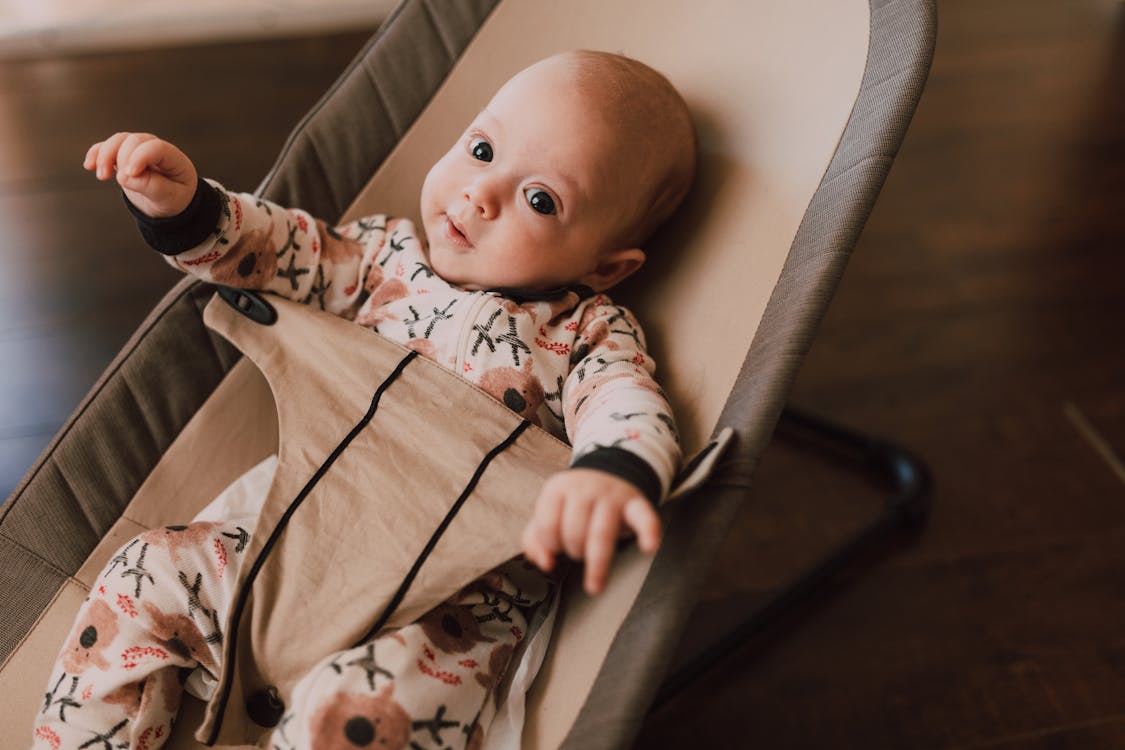
In practical terms: at this stage babies do not yet visibly respond to their name, but the brain already distinguishes it from other sounds. Consistent, repeated use of the name by familiar voices helps the pattern lock in.
Stage 2: 6 to 12 months: actively responding to the name
The American Speech-Language-Hearing Association (ASHA) lists responding to one’s own name as a milestone most babies reach between 6 and 9 months, and that should be consistent by around 12 months. A baby who turns their head when they hear their name, even without other context, is giving an important developmental signal.
This is also the stage in which parents themselves start to “notice it”. Before this age, many parents mistake general reactions to voice or tone for genuine name recognition. Only when a baby distinguishes their name from comparable terms of endearment (“sweetie”, “honey”) can we speak of name recognition at a behavioural level.
Clinically, this signal also matters: if a baby is not reliably responding to their name by 12 months, this can be a reason for further observation by a paediatrician or speech-language professional.
Stage 3: 18 to 36 months: name as a social label
Between 18 months and three years a child begins to use their own name actively. At first, this happens in the third person: “Lola wants biscuit”, “Sam pick up”. The first-person pronoun “I” only becomes stable later. This is not a delay but a normal step: the name functions as a social label before the abstract “I” concept is fully formed.
In the same period, self-recognition in a mirror appears (the Lewis and Brooks-Gunn rouge test demonstrated this from around 18 months) and children grow aware that others also address them by their name. A two-year-old hearing their name in a story or song actively connects it back to themselves.
Stage 4: 3 to 5 years: visual recognition and writing the name
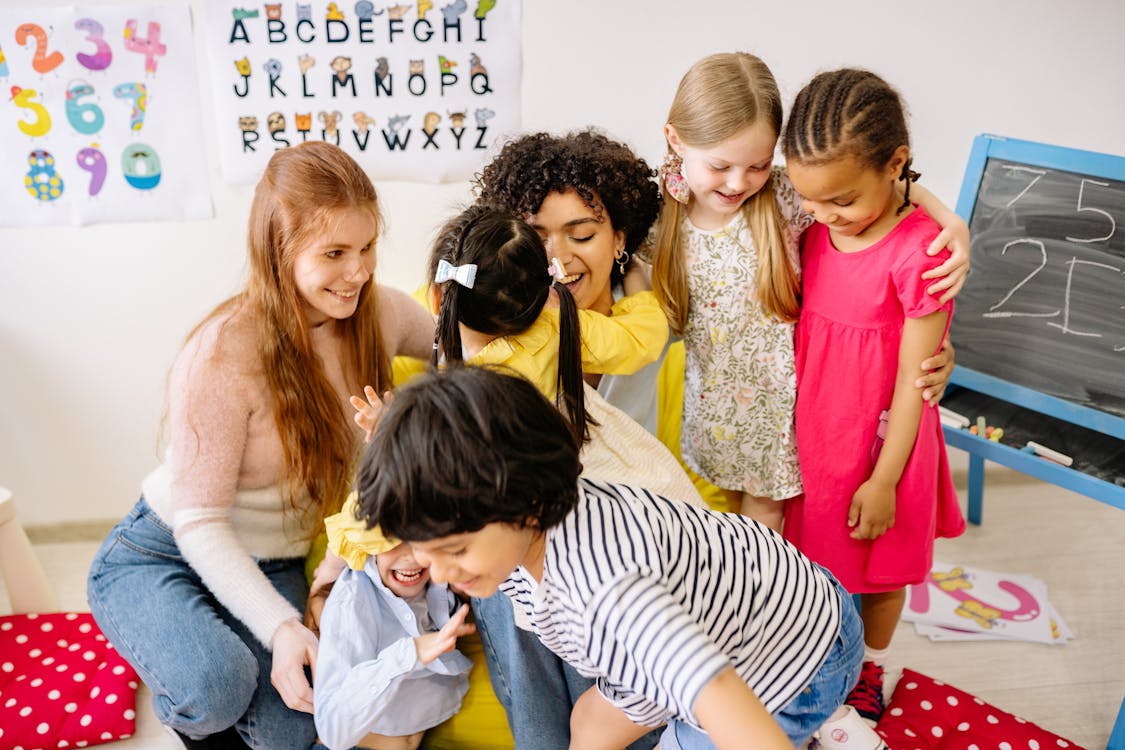
As children turn three, the centre of gravity shifts from sound to written language. Bloodgood, in her widely cited 1999 paper in Reading Research Quarterly, showed that preschoolers aged 3 to 4 recognise the letters of their own name earlier and faster than other letters of the alphabet. Recognising the first letter is usually a child’s first genuine letter-reading moment.
Welsch, Sullivan and Justice (Journal of Literacy Research, 2003) studied 3,546 preschoolers and confirmed: proficiency in writing one’s own name is strongly linked to letter-name knowledge, print awareness, and later reading and writing skill. Name writing is therefore not an isolated trick but a window into broader literacy development.
The pace varies. Around age three, a minority of children can already name a few letters, usually starting with the first letter of their own name. Between four and six, most children move into the stage where they can write their name recognisably, first in scribbles, then in separate letters, and finally as a flowing whole.
What this means for parents
The four stages together give an honest picture of what a child can do with their own name at each age:
- 0 to 6 months: the brain already distinguishes the name, but behaviour does not yet. Frequent, repeated use of the name supports the recognition pattern.
- 6 to 12 months: actively turning or responding, a milestone parents can themselves observe.
- 18 to 36 months: the name becomes a social label for one’s own identity.
- 3 to 5 years: visual recognition is added, beginning with the letters of the own name.
This explains why a personalised children’s book with the child’s own name can land with parents well before the child’s third birthday: the child hears something familiar, even if they cannot yet read the letters. From age three, visual recognition is added, and the effect becomes two-layered.
For parents who want to align with these stages, it helps to weave the name into daily rituals: greetings, story time, songs. A child does not need to read to be shaped by what they hear.
In summary
Research shows that name recognition is not a single moment but a build-up of four stages. From around 4.5 months the brain distinguishes the name, from 6 months visible responses appear, between 18 and 36 months the name becomes a social label, and from three years onwards children recognise the written letters of their own name. Understanding this developmental arc helps parents pick the reading, language and play moments that match each stage.
Curious how this looks inside an original story with your child’s name woven in? Browse our example books or create your own story right now.
Sources
- Mandel, D. R., Jusczyk, P. W., & Pisoni, D. B. (1995). Infants’ recognition of the sound patterns of their own names. Psychological Science, 6(5), 314 to 317.
- Imafuku, M., Hakuno, Y., Uchida-Ota, M., Yamamoto, J., & Minagawa, Y. (2014). “Mom called me!” Behavioural and prefrontal responses of infants to self-names spoken by their mothers. Neuroimage, 103, 476 to 484.
- Bloodgood, J. W. (1999). What’s in a name? Children’s name writing and literacy acquisition. Reading Research Quarterly, 34(3), 342 to 367.
- Welsch, J. G., Sullivan, A., & Justice, L. M. (2003). That’s my letter! What preschoolers’ name writing representations tell us about emergent literacy knowledge. Journal of Literacy Research, 35(2), 757 to 776.
- American Speech-Language-Hearing Association (ASHA). Communication milestones birth to five years.
- Lewis, M., & Brooks-Gunn, J. (1979). Social Cognition and the Acquisition of Self. Plenum Press.