Thanksgiving with kids: why 'say thank you' is not enough
Every Thanksgiving, somewhere between the turkey and the pie, a grown-up turns to a child and says: “Go on, tell everyone what you’re thankful for.” The child mumbles “my family” or “my Xbox”, everyone smiles, and the moment passes. In the United States that happens on the fourth Thursday of November, this year on 26 November 2026; in Canada it already happened on the second Monday of October.
It is a lovely ritual. It is also, according to researchers who have spent years studying gratitude in families, only a small part of what makes children grateful.
What the research actually looked at
Since 2012, a team of psychologists from the University of North Carolina at Chapel Hill, Duke and NC State has followed around 100 families with children who were six to nine years old when the study began. The project, Raising Grateful Children, led by Andrea Hussong, asked a simple question: what do parents do that makes a difference? (UNC, “Putting the ‘you’ in ‘thank you’”)
Their first finding is one many parents will recognise. Children as young as six already know the difference between saying thank you and meaning it. They would say things like “She said thank you, but she didn’t mean it.” What they lack, Hussong notes, is the perspective and the experience to feel it themselves.
Gratitude has four parts
The team breaks gratitude down into four steps, and the Thanksgiving ritual usually covers only one of them:
- Notice. What in my life is there to be grateful for?
- Think. Why was I given this? Did someone choose to do it for me?
- Feel. How does it make me feel that they did?
- Do. What do I do to show it?
“What are you thankful for?” is a noticing question. It skips the thinking and the feeling, and the doing is usually left to a polite “thank you” to whoever cooked. That is why the answers sound hollow: the child has named something, but has not connected it to a person or a choice.
A small change helps. Instead of “what are you thankful for?”, try “who did something for you this year that you didn’t expect?” That one question moves a child from noticing into thinking, because the answer is a person and a choice.
What parents did that worked
Three things stood out in the research.
- Everyday conversation beats the big speech. Parents who talked about gratitude briefly and often had more grateful children than parents who saved it for special occasions or moral lectures. A two-minute chat on the way home from a friend’s house counts more than a Thanksgiving sermon.
- Parents choose the situations. Grateful parents were more likely to put their children in situations that invite gratitude, such as helping a neighbour or volunteering together. The researchers call this “niche selection” (Rothenberg, Hussong et al., 2016, Applied Developmental Science).
- Children copy what they see. Children whose parents openly thanked each other, and the child, picked up the habit themselves.
When the ritual backfires
Forcing gratitude can do the opposite of what you want. A child who is made to list three things in front of the whole family, or who is told they “should be grateful”, learns that gratitude is a performance for adults. Shy children in particular dread the round of the table.
If that is your child, drop the public round. Ask the question quietly on the drive home instead, or let them draw the answer. And do not treat a “my Xbox” answer as a failure. It is honest, and it is a start: you can ask who gave it to them.
A gratitude practice without buying anything
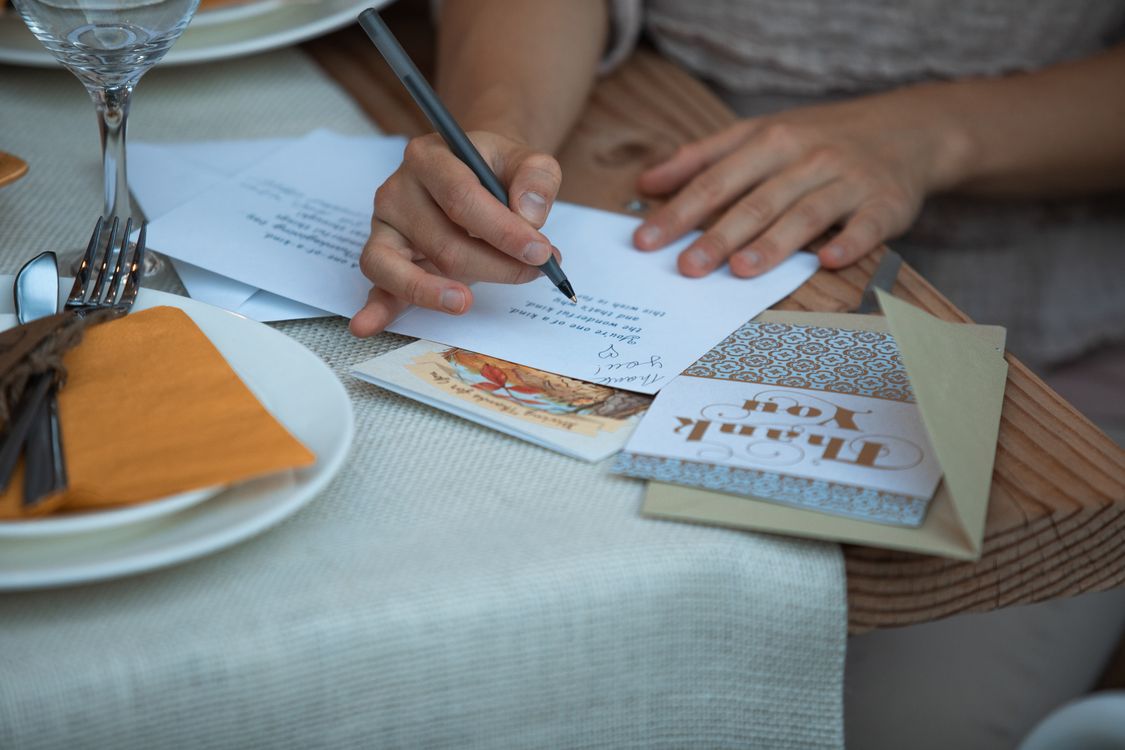
The most effective tools here cost nothing. A family “thank-you jar” where anyone can drop a note about someone else during November. A thank-you card that the child makes for the person who hosted, not because they have to but because you sit down and make one together. Or a phone call to a grandparent who could not come, where the child tells them one thing they remember doing with them.
That last one lands especially well, because it covers all four steps at once: the child notices, thinks about who, feels something and does something. For more on why grandparents are often the most moved recipients, see our piece on gifts from grandparents.
A story as a thank-you
A book can play a part in the “do” step. A story in which your child is the main character and the grandparents, the aunt or the neighbour appear alongside them is, in effect, a thank-you in book form: it says “you are part of my story”. Children like making one because they decide who is in it. How that works with your child’s name is explained on our page about a personalised children’s book, and if you are looking at gift ideas more broadly, our children’s book gift guide gathers the options.
What remains
The Thanksgiving round of the table is not the problem. The problem is treating it as the whole lesson. Gratitude, as the UNC team describes it, is how a child makes sense of what they have been given, and then acts on it. That takes the whole year, a few minutes at a time. The dinner is simply the one night a year when everyone is already sitting down to practise.
👉 Make a story with your child and the people they are thankful for