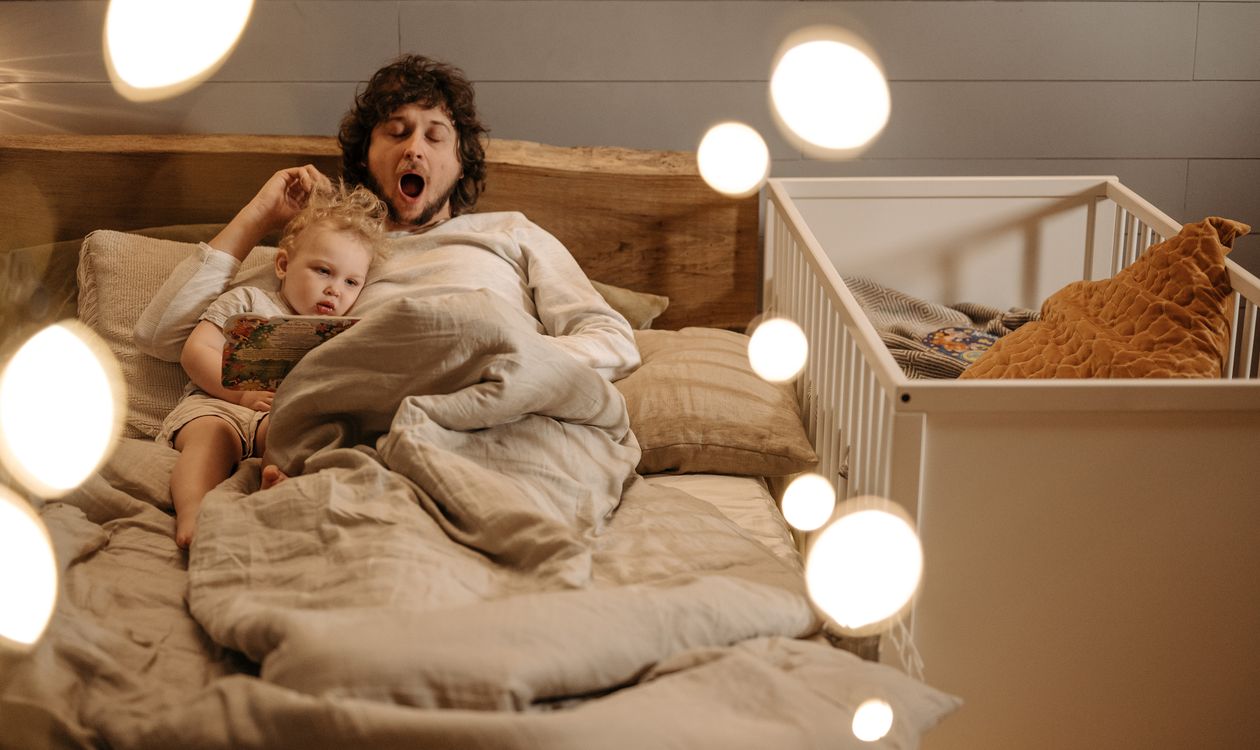
Clocks go back 2026: how to shift your child's bedtime
In the UK the clocks go back at 2am on Sunday 25 October 2026, to 1am GMT (GOV.UK). For adults that is an extra hour in bed. For a child who always wakes at six, it mostly means that from Sunday onwards they are standing by your bed at five.
This piece is about that one week: what is actually known about children and the clocks going back (less than you would think), how to shift bedtime, and why the bedtime routine matters more than the clock.
One note on dates before we start. In the US the clocks go back a week later, on Sunday 1 November (NIST). And if you are reading this in Sydney or Melbourne, it is the other way round: your clocks go forward on Sunday 4 October, which is the harder direction.
What research does and does not know
The honest part first. There is almost no published research on young children and the autumn clock change. A 2025 review in Sleep Medicine Reviews (Romigi and colleagues) brought together 27 studies on the clock change, with participants aged 6 to 85. Not one of them looked at children under six. The review’s conclusion: the spring change, when the clocks go forward, is the real problem. Autumn is milder.
What exists for small children are two conference posters. The first followed 510 children aged 3 to 24 months around the US autumn change of 2022, measured with a baby camera (Lucchini and colleagues, 2023). Total night sleep did not change. The middle of the night did land about ten minutes earlier in the week that followed, and the authors called the effects minor compared with spring. The second poster was about spring: babies needed about eight days to get back to their old rhythm, toddlers about three (Composto and colleagues, 2019).
A careful summary: for most children the clocks going back is not a drama. The problem is not that they sleep less, it is that they wake too early.

Shift gradually, or switch on the day
There are two approaches, and both are fine.
Shift gradually. The Sleep Charity suggests going to bed and getting up 10 to 15 minutes later each day in the week before; a sleep specialist at Norfolk and Suffolk NHS Foundation Trust gives the same advice for children. A plan for a child who currently goes to bed at 7pm:
- Monday 19 October: 7.10pm
- Tuesday: 7.20pm
- Wednesday: 7.30pm
- Thursday: 7.40pm
- Friday: 7.50pm
- Saturday: 8pm
- Sunday 25 October: 7pm on the new time, which is exactly the same moment for the body
Ten-minute steps, six evenings in a row. Move tea and bath time along with it, and keep the evenings light and the mornings dark.
Switch on the day. For children from about six, and for children who sleep flexibly anyway, simply using the new time from Sunday often works fine. Expect a few early mornings.
What helps with both is the morning. Keep the bedroom dark until the new getting-up time, and do not switch every light on when your child calls out at five. An ok-to-wake clock, the kind that changes colour when it is time to get up, can be a clear signal for children from about three, as long as you start using it a few weeks earlier.
Why the routine is the anchor
The clock moves by an hour, but a child does not read a clock. They read the order of things. Teeth, pyjamas, book, lights out: after this comes that, and then the day is over.
There is good research on that. In 2009 Jodi Mindell and colleagues published a study in Sleep with 405 mothers of children aged 7 to 36 months. Half of them introduced a fixed evening routine for three weeks: a bath, a massage, something quiet, and lights out within thirty minutes. Those children fell asleep faster, woke less often and for shorter spells at night, and the mothers’ mood improved measurably too.
A larger follow-up (Mindell and colleagues, 2015) asked more than 10,000 mothers in 13 countries how often there was a routine. The more nights a week, the better the sleep. Among parents with a routine every night, 23 per cent reported a sleep problem, against 47 per cent of parents with none. That is an association, not proof of cause. The American Academy of Pediatrics puts it in three words: Brush, Book, Bed.

In clock-change week that is the key. Move the whole sequence, but do not change the sequence itself. The book as the last step works well because a book has a clear ending: the cover closes and it is done.
What I notice about this research as a data engineer
I build data systems myself, and what strikes me is where these figures come from. The two clock-change posters use data from a baby camera and a sleep app. That gives large numbers, but they are parents who use that camera or app, and the researchers work for those companies. Mindell’s routine studies were funded by Johnson & Johnson, a maker of baby care products. That does not make them wrong, and the 2009 study is well designed. But it is worth knowing that independent research on small children and the clock change simply does not exist yet.
When you do not need any of this
If your child sleeps well and is six or older, do nothing special. The plan is for families with an early riser or a baby with fixed naps.
And if poor sleep carries on for two or three weeks, it is no longer the clocks. Then your health visitor or GP is a better place to go than a schedule. Do not start other big changes in clock-change week either, such as a new room or potty training. One thing at a time.

The book they already know
The best book for that week is the one your child has heard a hundred times. A familiar story does not surprise and does not raise questions, which is exactly what you want when the body is not quite sure what time it is. Why children want that one book again and again is in our piece on why children want the same book. It can just as well be a library book.
If you would like one made for this moment of the day, our bedtime stories with your child’s name are deliberately quieter than the rest, with a small problem and a last page to fall asleep on. And for anyone also wrestling with crying at night, we wrote earlier about what the research says about the cry-it-out method.
In the end the clock moves by an hour, and your child needs a few days to catch up. What carries those days is not the exact plan, but that everything around the clock stays the same.