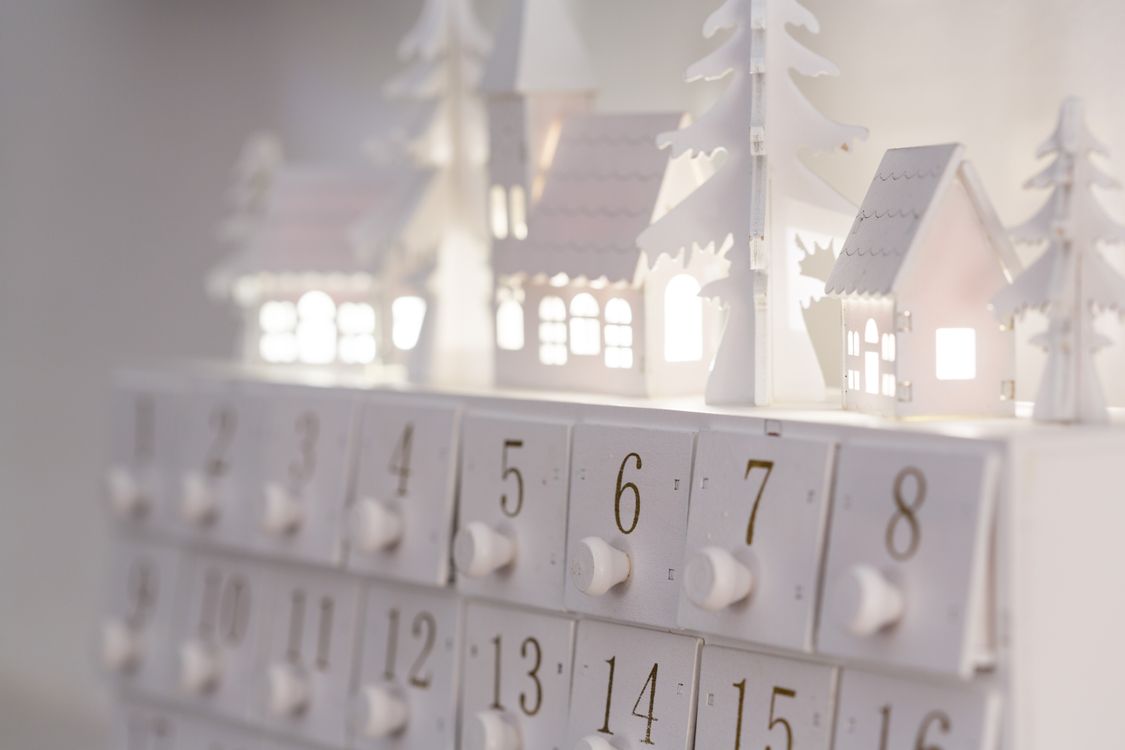
Filling an Advent Calendar: 23 Days and One Last Door
By mid-October, advent calendars are already back on the shelves, well before December even starts. Every year brings the same question: what do you put behind 23 small doors without it turning into a month-long stream of chocolate and plastic toys? And, perhaps more importantly, what do you save for the last one, the one that opens on Christmas Eve itself?
Most shop-bought calendars never answer that second question. They put the same kind of thing behind every door, a chocolate or a tiny figurine, right through to the 24th. The real trick isn’t what goes behind the 23 doors before it. It’s the contrast with what’s waiting on the final day.
Where the advent calendar actually comes from
The advent calendar is younger than it feels. German publisher Gerhard Lang grew up with a calendar his own mother made him: 24 Wibele biscuits sewn onto cardboard, one to pull off each day. Around 1903, Lang turned that childhood memory into a printed product, and in 1908 the Munich printing house Reichhold & Lang published what’s considered the first printed advent calendar, still without doors: 24 boxes with a short verse, plus a separate sheet of pictures to cut out and glue in (Wikipedia: Gerhard Lang). The little doors you tear open now only appeared decades later. From a sewn-on biscuit to a chocolate behind cardboard, the underlying idea has stayed the same for well over a hundred years: count down the days, and make each one a little bit special.
Why the countdown is the gift
In 1987, economist George Loewenstein published an influential paper on what he called “savouring”: the pleasure people get simply from looking forward to something good, separate from the moment itself (Loewenstein 1987, The Economic Journal). His model showed that the period before a pleasant event can deliver as much utility as the event itself, sometimes more. The same mechanism cuts the other way too: too much built-up expectation can tip into dread, which is roughly what happens when door 23 turns out to be a let-down after three weeks of build-up.
For an advent calendar, that has a practical implication. The pleasure doesn’t come from adding up 24 small presents. It comes from the fact that there’s something to look forward to every single day. A calendar that puts the same kind of content behind every door barely taps into that anticipation, it just repeats the payoff.
What actually goes behind the 23 doors
Aim for a mix, weighted towards doing something rather than simply receiving something:
- A walk past a street with Christmas lights, with a flask of hot chocolate afterwards
- Letting your child pick that evening’s bedtime story or song
- Decorating one small thing together, a single bauble, one string of lights
- Digging out an old jigsaw or a favourite comic from the library
- A joke, a riddle or a word game written on a slip of paper
- Letting your child choose dinner, or help with the baking
- Writing or drawing something for a grandparent or friend
- A small photo moment your child gets to choose
This kind of door costs very little and doesn’t wear thin. It’s also far easier to keep up for a whole month than hunting for 23 new small objects in the shops.

Why smaller often works better than bigger
Researchers Chaplin and John tracked children and teenagers aged eight to eighteen and found that materialism rises with age, but tracks self-esteem more closely than anything else: children with lower self-esteem placed more value on possessions (Chaplin & John 2007, Journal of Consumer Research). Their study wasn’t about advent calendars specifically, but the lesson carries over: a calendar that has to escalate, bigger and pricier every single day, trains exactly the pattern that study links to weaker self-esteem. Small and predictable isn’t a shortfall, it’s something to hold onto.
That’s also why making something together tends to stick more than simply receiving it, something we’ve written about before in our piece on the IKEA effect and homemade gifts: people consistently value things more when they’ve helped make them.

When an advent calendar doesn’t work
Under two or three, counting down doesn’t mean much yet. At that age, the calendar is mostly a ritual for the parents rather than something the child experiences as a genuine countdown, and that’s fine as long as you don’t expect more from it. Watch out too with several children taking turns to open a door: that can turn into a daily negotiation faster than a shared moment. If that’s a risk in your house, a few smaller calendars per child usually work better than one big one everyone has to queue for.
The alternative: flip the calendar
A reverse advent calendar costs nothing and works just as well as a ritual: instead of receiving something each day, the family adds one item to a box for a food bank or charity, a tin of soup, a bag of rice, a pair of socks. On the 24th, the box goes out the door. Children from around five understand the difference between receiving and giving perfectly well, and it’s a solid option for anyone who simply doesn’t fancy filling yet another calendar with small objects.
The last door: something that stays
The 23 doors before it are allowed to be fleeting, a biscuit eaten, a song heard, a walk taken. That’s exactly why the final door is the place for something that isn’t gone five minutes later. In Iceland, Christmas Eve is traditionally the night you receive a book and read it there and then, a tradition known as jólabókaflóð. A book with your child’s own name in it, along the lines of our page on a personalised children’s book, fits behind the last door for the same reason: it isn’t a chocolate that’s forgotten by nine o’clock, it’s something still on the shelf long after the school holidays end.
What the countdown is really worth
An advent calendar with 24 identical doors is a missed opportunity. The contrast is what makes it work: 23 small things that make the waiting enjoyable, and one that lasts. That distinction doesn’t cost anything extra, just a bit of thought beforehand, and it’s exactly the kind of detail a child remembers years later, not the door from the 9th of December, but the feeling of the whole month.