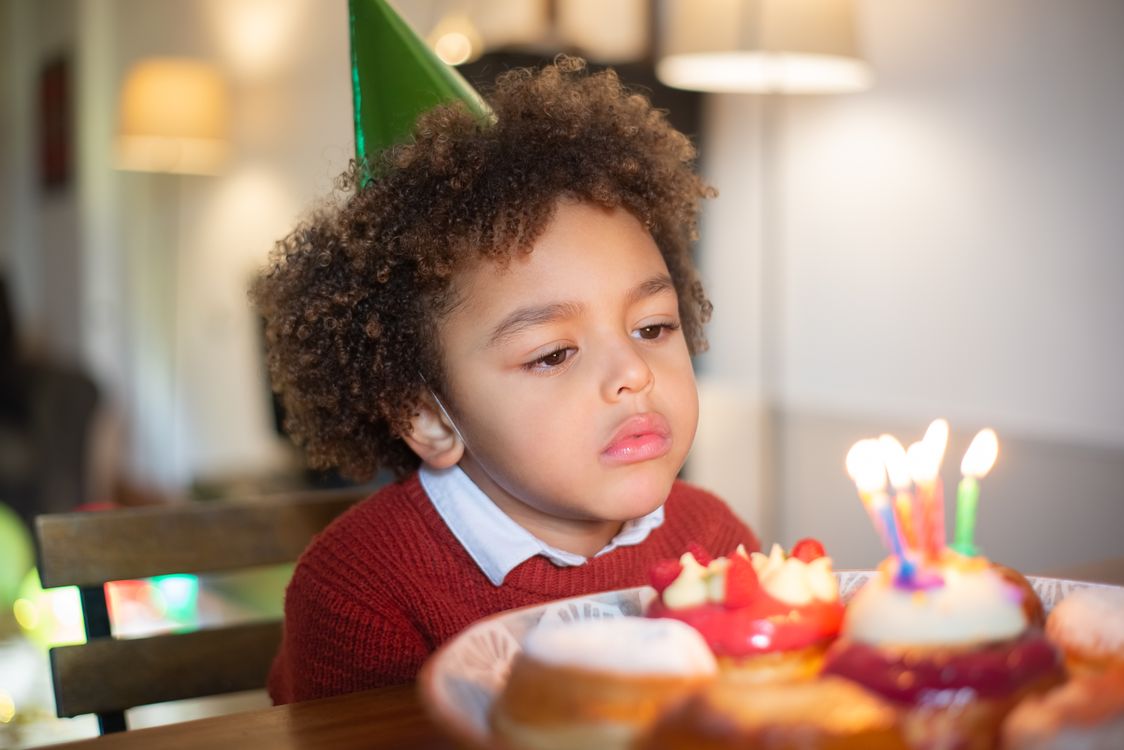
An original birthday present for a child: making a book
Anyone who has been to a five-year-old’s birthday party knows the scene: twenty minutes of tearing paper, then a pile of things, half of which are under the sofa a week later. An original birthday present for a child is therefore not the one that gets the loudest “oh!” when it is unwrapped. It is the one that is still being used three months later.
That sounds like an opinion, but there is research behind it. Below we first look at what that research says, and when you are better off giving something else. Then we take you through making a personalised children’s book. For this post we actually made one, on a phone, for an invented five-year-old girl called Noor. You will see every screen.
What makes a birthday present original?
Givers think about the unwrapping, receivers about afterwards
In 2016 psychologists Jeff Galak, Julian Givi and Elanor Williams brought together the research on gift-giving (Current Directions in Psychological Science). Their conclusion: givers choose with the moment of unwrapping in mind, going for surprise and the wow factor. Recipients value a present mostly for what it does afterwards. That is the difference between a present that looks original and one that really is.
With children, “afterwards” is very concrete. Is it played with, read, picked up again and again?
Repetition is not a weakness
Children want to hear the same story ten times. That is not a lack of taste. In an experiment by Jessica Horst and colleagues, three-year-olds learnt more new words when they heard the same stories repeatedly than when they heard different ones each time (Frontiers in Psychology, 2011). A book a child keeps reaching for does more than one that is only lovely the first time.
A thing that holds on to a memory
With adults, the experience often wins: Cindy Chan and Cassie Mogilner showed that experiential gifts strengthen the bond between giver and receiver more than material ones (Journal of Consumer Research). With young children it is different. Across four studies, Lan Nguyen Chaplin and colleagues found that children aged 3 to 12 are actually made happier by things than by experiences; only older teenagers switch (International Journal of Research in Marketing, 2020). A five-year-old forgets a day out faster than we think. A book about things the child really knows, like the bakery on the corner or grandma’s vegetable patch, sits in between: a thing a child can hold, which holds on to an experience.
When it is not a good idea
A book with the child as the hero does not always work. Four situations where something else is the better choice:
- There is a wish list. Francesca Gino and Francis Flynn found that recipients appreciate requested gifts more than givers expect (2011). If the child has been asking for one thing for months, give that. A book can come with it, not instead of it.
- The child dislikes attention. Some children feel uncomfortable seeing themselves as the hero. If you do not know the child well, choose a good ordinary picture book.
- The child is under one. A sturdy board book is a better choice at that age; a story of eleven pages can come later.
- The party is the day after tomorrow. A printed book has to be printed and posted, so allow at least a working week. If that is too tight, give a card with the digital version and let the book follow.
Other original options
A personalised book does not have to come from us. You can write a story yourself and have it printed as a photo book with your own pictures. It takes more time, but you control everything. Wonderbly and other makers offer fixed stories in which mainly the name changes. And a day out to the place the child dreams about is a lovely present, especially for older children. With young children, take photos as well, so something tangible remains. Why something you helped make feels more valuable is explained in our piece on the IKEA effect and homemade gifts.
How to make the book: every screen
On 14 October 2026 we made a book from start to finish, on a phone. We made the book itself in Dutch; the screens below are from this site and work exactly the same way. Here is what you see, and what struck us.
Step 1: choose an illustration style
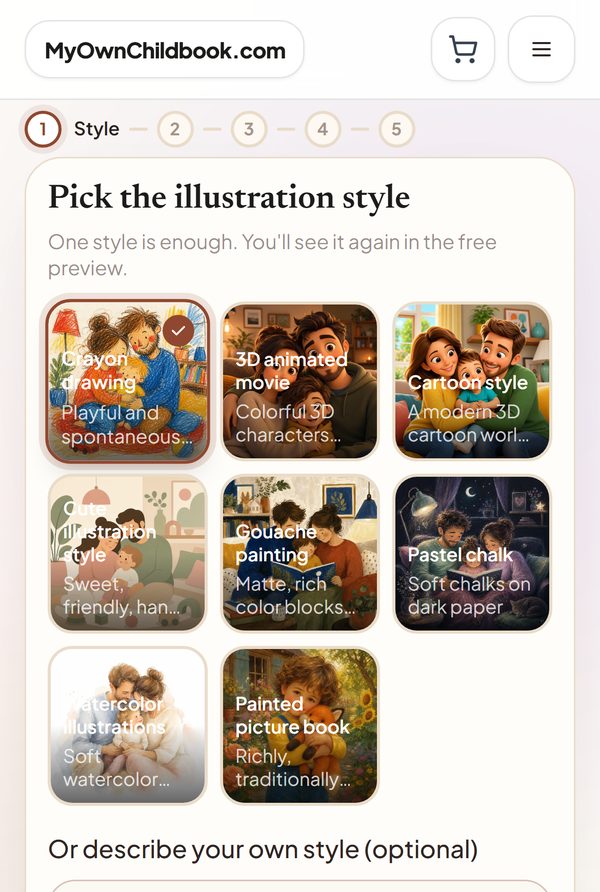
There are eight styles. You pick one and see it again in the free preview. We chose crayon drawing, because it suits a five-year-old who loves to draw. Unsure? Browse the example books first.
Steps 2 and 3: who is the main character, and what do they look like?
In step 2 you only fill in the name. You can add more main characters, such as a little brother or the dog. In step 3 you describe their appearance or upload up to five photos.
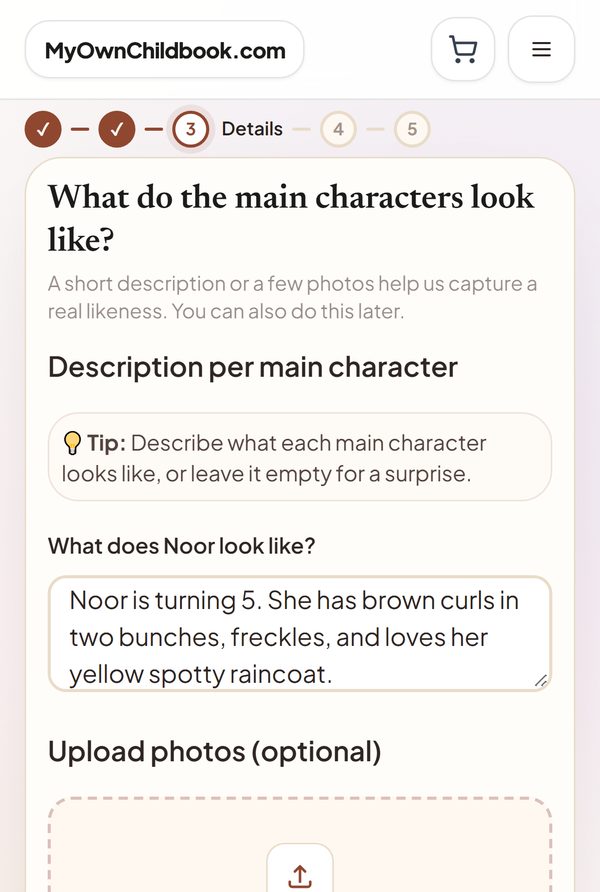
What struck us: whatever you leave out, the AI fills in on its own. We mentioned curls, freckles and a yellow raincoat. In the proposal, Noor had also been given blue trousers and red wellies. If something matters, like glasses or a cuddly toy that goes everywhere with her, write it down. Photos make the likeness stronger. What happens to those photos is explained in our article on children’s photos and privacy.
Step 4: what is the story about?
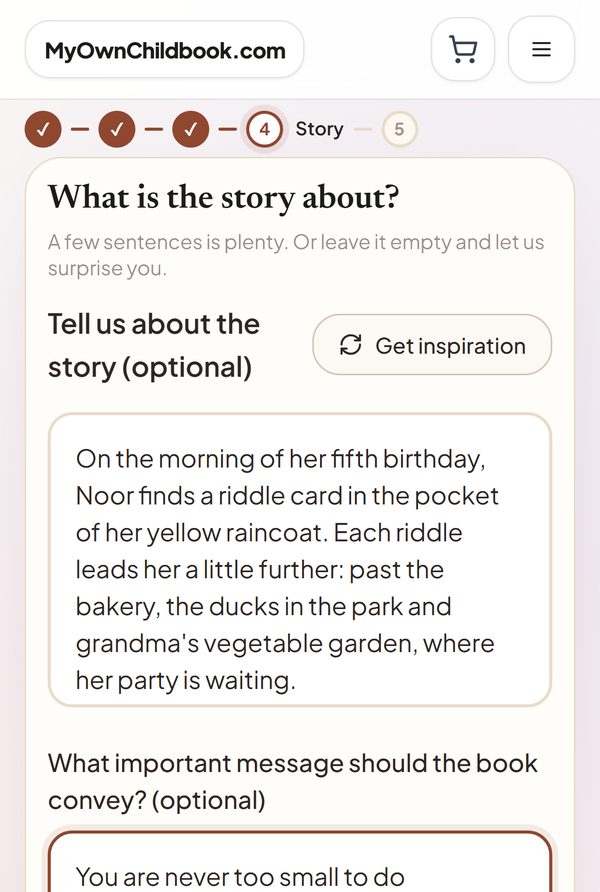
This is where a book with a name becomes a book about this one child. We wrote three sentences with three places from Noor’s world: the bakery, the ducks in the park and grandma’s vegetable patch. Below that you can add a message. We chose: “You are never too small to do something big.”
Name places, people and things the child recognises. The more familiar the setting, the more often the child will point at the pictures while you read. On the last screen you add a dedication for the front of the book and your email address, then tap “Create my book”.
Step 5: check the proposal
A few minutes later a proposal was ready: a mood image and the story page by page.
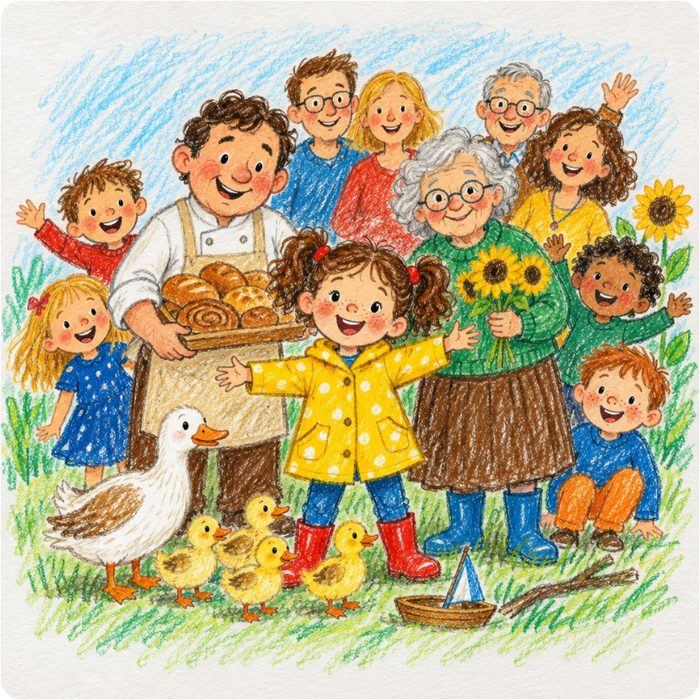
The mood image is the basis for every page: the way the characters look here is the way they look throughout the book. So look at it carefully. Ours showed a whole crowd: the baker, grandma and the ducks, but also parents and friends we had never described. If you want it different, type what should change under “Tweak a character”, for example “give grandma glasses”. You get fifteen adjustments.
Below the image are the title and the story, page by page, and you can edit that text. Our book was titled “Noor and the Big Secret”. What surprised us most: the message did not arrive as a moral at the end, but ran through the whole story. Noor gathers up the baker’s blown-away bunting, moves a branch aside for the ducklings and untangles a party garland in grandma’s garden. In the proposal, the story ended like this: she is still small, but thanks to her this birthday became a very big one.
Read the proposal aloud. Whatever sounds odd when read aloud will sound odd in the book too.
Step 6: first the preview, then you pay
After you approve, all the pages are illustrated. The site says “about 1 hour”; ours was ready in just over ten minutes. You get an email and can look through the whole book for free.
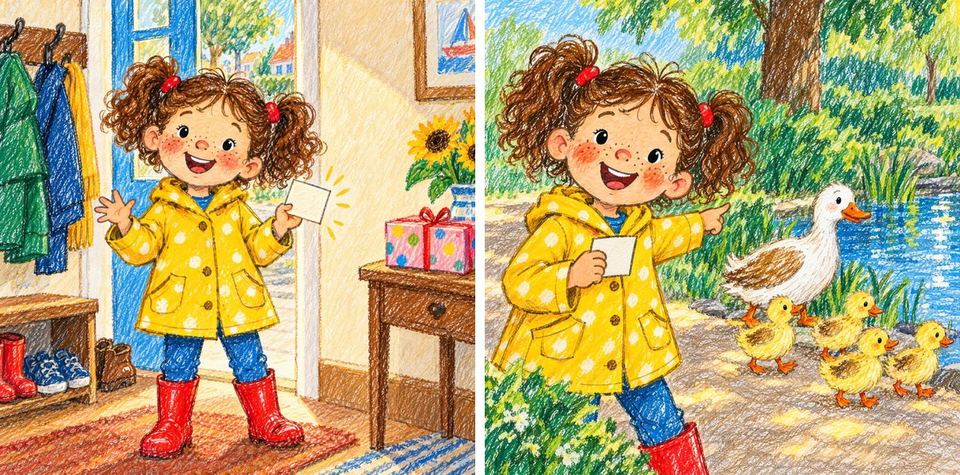
The cover wraps around from back to front: the baker and the ducks on the back, Noor and grandma on the front. Inside, text pages and illustrations alternate. The story from the proposal had been turned into short read-aloud lines, four per page. The final line, translated: “Even someone small can be a big helper!”
What struck us most: Noor looks the same on every page, with the same bunches, freckles and yellow coat. That is what the mood image in step 5 is for. If something is still not right, you can change the text, the pictures or the cover in the preview. Only when you are happy do you order it as a hardback. Would you rather not invent a story yourself? On the birthday book page you can choose from ready-made birthday stories and still make them personal.
What we learnt
What makes this present original is not the technology but the three sentences in step 4. A book about the bakery on the corner and grandma’s vegetable patch becomes the book a child keeps reaching for. According to the research, that is exactly what a good present does: it works not at the unwrapping, but afterwards. So take five minutes to write down what the child is into this month before you start.