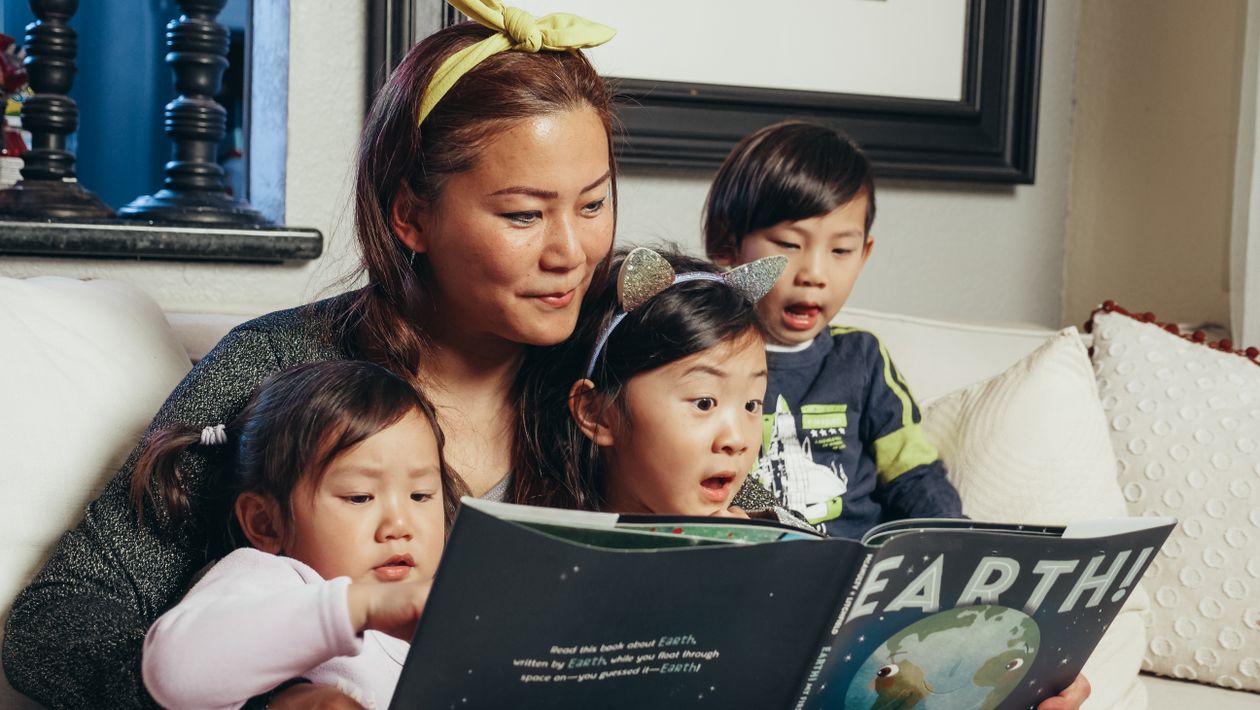
When reading aloud backfires (and what to do instead)
Reading aloud is one of the few parenting tips almost nobody argues with. Yet as a parent you sometimes feel it isn’t working: your child wriggles, wants to leave after two pages, or asks for the same book for the seventh time. Does that mean you’re doing something wrong?
Usually not. But some ways of reading aloud give less back than you hope, and you can learn to spot them. This piece walks through them, with what the research does and does not say. That last part matters, because there is less evidence that reading aloud harms than headlines online suggest.
First the honest part: harm is hard to show
Search for research on reading aloud that does children damage and you find almost nothing. What exists is research showing that the effect is smaller than people assume and depends on how you read. The big 2011 meta-analysis by Suzanne Mol and Adriana Bus in Psychological Bulletin pooled 99 studies with 7,669 participants. In preschoolers and kindergartners, exposure to print explained about 12 per cent of the differences in oral language skills. That is real, but it is no magic formula: 88 per cent comes from other things.
So what follows is not a list of dangers. These are situations where the payoff from reading aloud probably disappoints, or where you may cost your child some enjoyment. Where the research is thin, I say so.
1. The child looks at the pictures while you read the words
You may picture your child following along as you run a finger under the line. Eye-tracking research by Evans and Saint-Aubin (2005, Psychological Science) found that four- to five-year-olds look at the printed words only about 7 per cent of the time during shared reading. The rest of the time they look at the pictures. That is not failure; it is how a child of that age reads a picture book.
It does mean that a book with nothing to look at, or a session where the child has nothing to do but sit still, loses much of its power. The picture is the learning tool. So wait before turning the page until your child has finished looking.
2. Pushing on regardless
The evidence is thinnest here, but it makes sense. Linda Baker and Deborah Scher (2002, Reading Psychology) studied beginning readers’ motivation in relation to what parents believed and did. Their conclusion was that you have to look beyond the number of hours at home: how the reading goes counts too. A child who has to sit through fifteen minutes every evening while longing to do something else mostly learns that books are an obligation.
A practical rule of thumb: stop when attention has gone. Two pages with attention give more than ten pages while your child stares at the ceiling. For very young children a few minutes is often enough; I did not find a fixed norm for that.
3. Reading aloud as a monologue
Kathryn Fletcher and Elaine Reese (2005, Developmental Review) brought together research on picture book reading with young children in one framework. A recurring point: what a child gets out of it depends heavily on how much they get to say, point at and ask. If you only read out the text, you leave that gain on the table.
You don’t need to learn a technique. Just ask a question that can’t be answered with yes or no (“what do you think happens now?”). If you want a method, read our explanation of dialogic reading with the PEER technique.
4. A book that doesn’t fit the child
A book that is too hard, too abstract or too long passes straight over a child’s head. That includes the “sensible” book you would love to read aloud. Children need books in which they recognise something: an animal they know, a situation from home, a character who resembles them. Recognition holds attention.
Repetition belongs here too. If your child wants the same book again, that is not a sign you are missing something; it is how they learn. There is more on that in why children keep asking for the same book.
5. Reading at the wrong moment
Reading as a last resort when everyone is tired, or as a reward you then take away (“no story if you don’t listen”), turns a calm moment into a negotiation. A bedtime book works best as a fixed, predictable part of the evening. How that fits with bedtime is covered in our piece on bedtime and the clocks going back.
When this advice does not fit
This piece assumes a healthy, curious child from about twelve months to six years. For a child with a language delay, hearing difficulties or a diagnosis such as ADHD or autism, reading aloud may work differently: shorter, with more touch, or with even more repetition. If you are unsure, ask your health visitor or a speech and language therapist. That is not a sign of weakness but the quickest route to something that works.
An alternative that isn’t a book
If reading aloud really isn’t working for you right now, there is nothing wrong with telling a story without a book, making up a tale together about the day, or playing an audio story. On that last option, see reading aloud versus audiobooks and screens. What matters is the shared story, not the paper.
Where a book with their name fits
A book in which the child is the main character doesn’t fix everything, but it does tackle one of the problems above: recognition. The child sees themselves, their name and their surroundings, and often has more to say and point at. For some children that is exactly why they keep listening. For children who dislike the spotlight it can backfire, so see first how your child reacts to their own name in a story.
The core of it: reading aloud doesn’t work because you do it, but because you do it together. If you are looking, talking and laughing together, you are doing it right. Which book, how long and how often come second.
👉 Make a book with your child as the main character
Sources
- Mol, S.E., & Bus, A.G. (2011). To read or not to read: A meta-analysis of print exposure from infancy to early adulthood. Psychological Bulletin, 137(2), 267-296. doi:10.1037/a0021890
- Evans, M.A., & Saint-Aubin, J. (2005). What children are looking at during shared storybook reading: Evidence from eye movement monitoring. Psychological Science, 16(11), 913-920.
- Baker, L., & Scher, D. (2002). Beginning readers’ motivation for reading in relation to parental beliefs and home reading experiences. Reading Psychology, 23(4), 239-269.
- Fletcher, K.L., & Reese, E. (2005). Picture book reading with young children: A conceptual framework. Developmental Review, 25(1), 64-103.