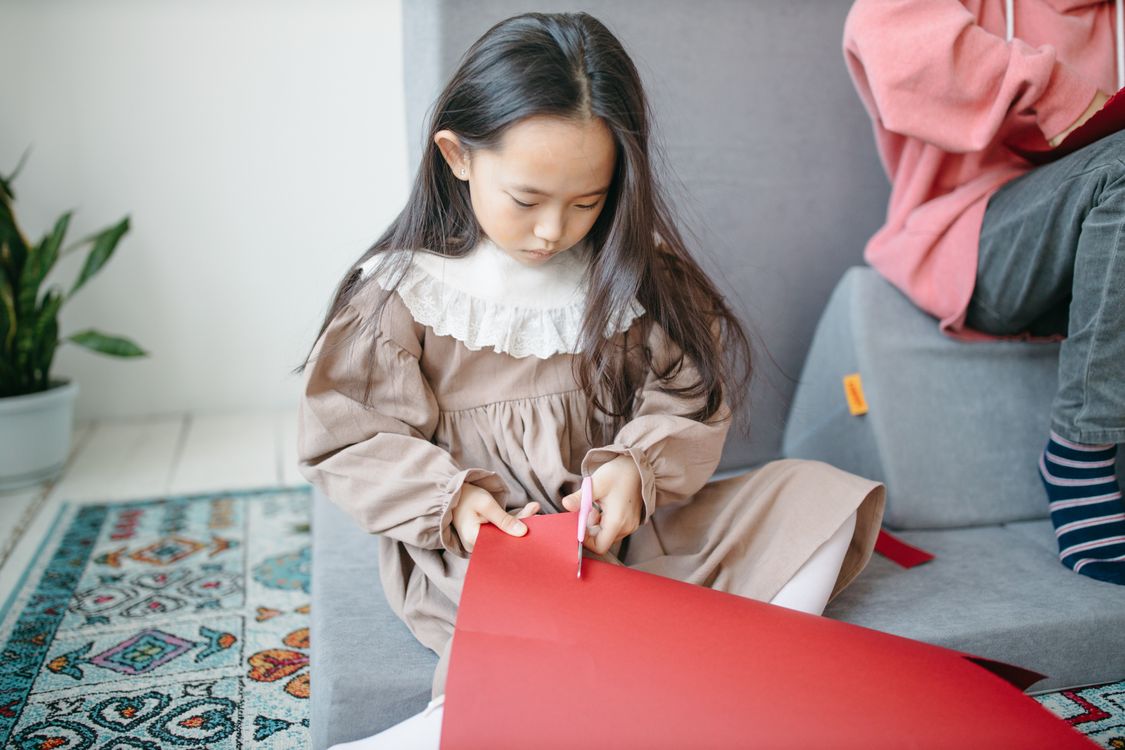
Scrapbook or personalised children's book: which fits?
Every year the same good intention turns up in parents and grandparents: this year I will make a proper album. Ticket stubs, a little arrow drawn next to the best photo, a sentence about what happened that day. By December the album is in a drawer with three pages done. That is not failure. It is what happens when a lovely idea needs time you do not have.
This comparison is for anyone choosing between making a scrapbook yourself and ordering a personalised children’s book in which your child is the main character. They do different jobs, and for some children and some parents the scrapbook is simply the better choice.
What a scrapbook can do that a printed book cannot
A scrapbook is real. The tickets are real, the handwriting is real, and the zoo ticket really does have a crease in it. For a child growing up, that is what makes an album valuable: proof that it happened.
Research by Marshall Duke and Robyn Fivush at Emory University shows why this matters. They developed the “Do You Know?” scale, twenty questions such as “do you know where your grandparents grew up?”. Children who knew more of their family stories tended to have a stronger sense of control over their lives and higher self-esteem (Duke, Lazarus & Fivush, 2008, in the journal Psychotherapy). Mind the limits: this is a correlation, not proven cause, and the researchers stress that it is the telling of stories that counts, not memorised facts.
That is the scrapbook’s strongest side. It is a pile of prompts for talking: “do you remember when we …?”. A six-year-old leafing through an album with a grandparent hears stories that no printed book contains.
What a personalised children’s book does differently
A personalised book is not an album but a story. Your child (with their name, and perhaps an appearance that resembles them) has an invented adventure and is read to like any other picture book. It does not keep a memory of what happened. It gives a child something to hear again and again.
That difference matters. You look through a scrapbook now and then, on a rainy afternoon or at a birthday. A story book, if it lands, is read dozens of times. Children often ask for the same book a hundred times, and a book with their own name in it is a good candidate.
The comparison at a glance
- Time: a scrapbook takes a few evenings a year. A book takes about an hour to fill in and a few days of waiting. With the first you set the pace.
- Cost: a scrapbook costs materials, roughly acid-free paper, glue, stickers and a good binder, plus your own time. A personalised book costs more than the materials alone, but you receive a printed, bound result.
- What is in it: a scrapbook is what really happened, full of detail. A children’s book is an invented story around your child.
- Durability: archival paper and acid-free glue can last decades. A bound book is sturdier in small hands.
- Whose gift: a scrapbook is something you make for yourself, your child or each other. A book is easier to give as a present, for example from a grandmother who is not crafty.
When a personalised book does not fit
A personalised book is the wrong choice if you want to keep the real story. A first day at school, the death of a pet, a special holiday: you will want to capture that with real photos and your own words. An invented story cannot replace it and is not meant to.
It also does not suit a child who is clearly uncomfortable being the main character. For some children a book about an animal, with only the name included, works better than a book that looks a lot like them.
The third alternative: just write one yourself
There is a route without glue or a printer: write a short story for your child. A single page of your own invention, read aloud at bedtime, is for many children at least as valuable. All you need is an idea and three minutes, and you can change it every night. You can have your story printed later if you like, but it works perfectly well without.
Two books, two moments
In practice they complement each other. The scrapbook comes out at special moments, while a story book fits the regular reading ritual. That is our impression from what parents tell us, not a research result: as far as we could find, no study compares the two.
How to choose
Ask yourself three things. Do I want to keep something that happened, or give something to read aloud? Do I have the time and the wish to stick things in myself? And who is it for: my own child, or someone giving a gift?
For many families the honest answer is both, though not in the same year. Start with the scrapbook if you want to capture a special year. Choose a story book if your child is at the age of wanting the same book every night. To see what such a book looks like, browse the examples or read everything about a children’s book with a name. For more on why homemade gifts land so well, see the IKEA effect, and for the cases where a personal book does not work, when a personalised book doesn’t fit.
A scrapbook tells what was. A story book tells who your child could be. You know best which of the two your child needs.