
Which Diwali story do you tell your child?
Ask a child in a British primary school what Diwali is about, and you will usually hear the story of Rama and Sita: the prince who rescues his wife from the demon king Ravana, and the people of Ayodhya who light lamps to guide them home. Ask a grandmother in Chennai or Kolkata, and you may hear a completely different story.
That is not a mistake. Diwali, which this year falls on Sunday 8 November 2026 with Lakshmi Puja that evening, is one festival of lights with several reasons behind it. For families living far from where their grandparents grew up, choosing which story to tell a child is a real question.
Six stories, one festival
The lamps are shared by everyone. The story behind them depends on region and faith (Wikipedia: Diwali):
- Rama’s return (widespread, especially in north India). Rama, Sita, Lakshmana and Hanuman reach Ayodhya after fourteen years in exile and the defeat of Ravana. The lamps welcome them home.
- Krishna and Narakasura (south India and the Braj region). Krishna defeats the demon Narakasura and frees the people he held captive. The day before Diwali, Naraka Chaturdashi, marks that victory.
- Kali (east India, particularly Bengal). The festival is linked to the goddess Kali and the victory of good over evil; the main night is Kali Puja.
- Lakshmi (across Hindu traditions). Many families connect Diwali with Lakshmi, goddess of prosperity, who is welcomed into clean, well-lit homes.
- Mahavira (Jain). For Jains, Diwali marks the nirvana of Mahavira, the 24th Tirthankara.
- Bandi Chhor Divas (Sikh). Sikhs celebrate the release of Guru Hargobind from imprisonment in Gwalior Fort.
What they share is the image at the centre: light returning after darkness. That is the part a young child grasps first.
Telling it at three: the light that shows the way
A three-year-old does not follow a fourteen-year exile or a battle with a ten-headed king. They do understand a dark evening and someone finding their way home. Start there: it is dark, someone we love is coming home, and we light lamps so they can find us. Then light one together.
Keep the demon out of it at this age, or make him small. The lamps are the story.
Telling it at five: good and bad, and who helps
Around five, children want a hero, a villain and a reason. This is the age for the full Rama and Sita story, or Krishna and Narakasura, told with the helpers in: Hanuman the monkey, the bridge built across the sea. Children at this age love the idea that the hero could not have done it alone.
It is also a good age to connect the story to what the family does. Why do we clean the house? Why do we draw a rangoli at the door? Each custom becomes a small part of the story the child can take part in.
Telling it at eight: why there are different stories
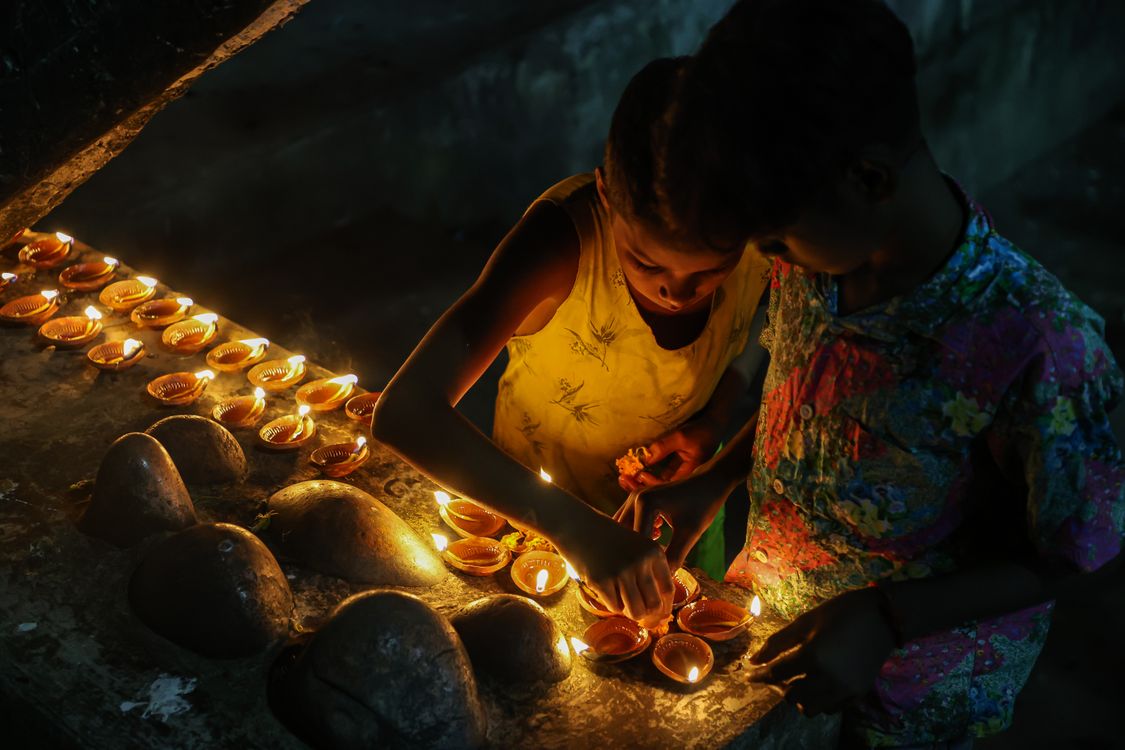
By eight, many children notice that their school version differs from their grandparents’ version, or that a friend’s family celebrates for a different reason. That is a gift, not a problem. You can explain that Diwali is older than any single retelling, that different communities remember different victories, and that Jain and Sikh families have their own reasons for lighting the same lamps.
For children growing up outside India, this is often the conversation that makes the festival theirs. It stops being “the thing we do at home that nobody at school understands” and becomes something they can explain to others.
When a story is not what the day needs
Not every Diwali has room for storytelling. The five days are busy: cooking, visits, prayers, fireworks, relatives on video calls from another time zone. A child who is overtired by the evening of Lakshmi Puja will not take in a myth, however well told. Tell the story in the week before, when the house is being cleaned and the lamps are being bought, and let the day itself be about the light and the people.
And if your family does not celebrate for religious reasons but for cultural ones, you do not have to pick a deity at all. “We light lamps to remember that good things come back after hard times” is an honest story too.
Without buying anything
The best Diwali stories are the family’s own. Ask a grandparent to tell how Diwali was when they were small: what they ate, what they were allowed to do, which relative always burnt the sweets. Record it on a phone and play it back next year. Children who hear their own family’s memories alongside the old myths understand that a festival is something people keep alive on purpose.
A rangoli drawn together at the door, or a set of clay diyas painted by the child, does the same. It makes them part of the tradition rather than a spectator.

A Diwali story with your child in it
Some families like to add one more story: one in which their own child lights the lamps, helps someone find their way home, or discovers why the house is glowing. A personalised book puts the child’s name inside that story, and grandparents abroad often treasure it as a gift. How that works is explained on our page about a book with your child’s name.
We have written before about other moments for families with roots in India: the Namkaran naming ceremony, Children’s Day on 14 November, and giving a book in the family’s mother tongue.
What remains
There is no single correct Diwali story, and that is precisely what makes it worth telling well. Whichever version your family keeps, a child who knows why the lamps are lit, and knows that other families light them for other reasons, owns the festival in a way that fireworks alone never give. The lamps come back every year. So can the story, a little deeper each time.